Early Numeracy in Preschool: How Children Learn Numbers, Shapes and Patterns Through Play
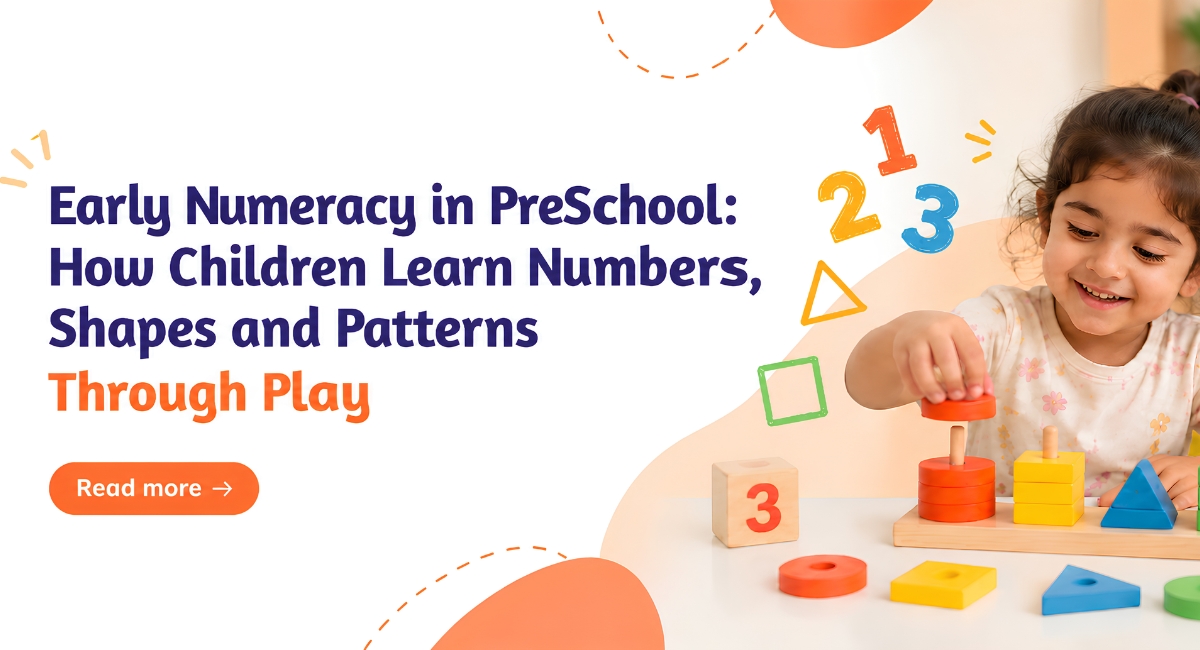
Table of content
1. Introduction
2. Why Early Numeracy Activities for Preschoolers Matter
3. Early Numeracy Activities for Preschoolers: Learning Through Real Objects
4. Number Activities for Preschoolers: Building Meaning Before Memorisation
5. Preschool Early Numeracy Activities for Counting and Comparing
6. Preschool Early Numeracy Activities for Learning Shapes and Space
7. Early Numeracy Activities for Preschoolers Using Patterns and Sorting
8. Early Numeracy Activities for Preschoolers Through Stories and Games
9. Building Early Numeracy Skills Through Everyday Preschool Play
10.How Parents Can Support Early Numeracy at Home Without Pressure
11.Conclusion
12.Frequently Asked Questions
Introduction
Young children begin using numbers much before they open a maths book. They notice who has more toys, count steps, arrange blocks by size, recognise circles and squares and spot repeating colours in everyday objects. These simple experiences form the beginning of mathematical thinking. Well-planned math activities for PreSchoolers build on this natural curiosity through play, conversation and hands-on exploration instead of expecting children to memorise numbers or complete long worksheets.
Why Math Activities for PreSchoolers Matter in the Early Years
Early numeracy is much wider than learning to say numbers in order. Children gradually develop ideas about quantity, size, position, matching, sorting, shapes, patterns and measurement. These concepts create a foundation for mathematical learning in later years.
Early Numeracy includes understanding numbers, simple counting, shapes, space, patterns and sizes. Children learn these ideas best through hands-on activities that they can see, touch and explore. This means a PreSchool child may understand “more” and “less” better by comparing two groups of blocks than by looking at symbols on a worksheet. The experience comes first and formal representation gradually follows.
Early Numeracy Activities for PreSchoolers: Learning Through Real Objects
Young children understand concepts more easily when they can handle real objects. Buttons, blocks, toy animals, beads, leaves and safe household items can become simple counting materials.
A teacher might ask children to arrange blocks from small to big, find two objects of the same shape or divide toy fruits into different groups. These activities introduce comparison, classification and mathematical vocabulary without making the experience feel like a formal lesson. Using physical objects like blocks and beads helps young children learn math concepts much more effectively because they learn best through hands-on exploration.
Number Activities for PreSchoolers: Building Meaning Before Memorisation
Number activities for PreSchoolers should help children understand that a number represents an actual quantity. Saying “one, two, three, four” is useful, but meaningful learning happens when a child can connect the spoken number with a group of objects.
Teachers can invite children to count crayons before an art activity, count how many friends are sitting together or place the correct number of blocks beside a number card. These small experiences support number recognition for PreSchoolers while helping children understand what each number means. According to UNICEF early maths through normal routines, such as counting objects at home and talking about quantities during everyday activities. This helps children see mathematics as something connected with real life.
PreSchool Math Activities for Counting and Comparing
PreSchool early numeracy can turn counting into something children actually need during play. Instead of repeating numbers only as a rhyme, children can count objects while building, sharing or organising materials.
Simple counting activities for PreSchoolers may involve giving each toy one plate during pretend play, counting steps while walking or checking whether two groups have the same number of objects. Experiences like these introduce ideas such as more, less, equal, first, last and how many. Games can also make counting enjoyable. Simple games, blocks and recreational mathematics can strengthen counting, spatial reasoning, strategy and problem-solving skills.
PreSchool Early Numeracy & Cognitive Activities for Learning Shapes and Space
Children see shapes everywhere. A plate may be round, a window may look rectangular and a building block may have square faces. Pointing out these familiar examples can make geometry meaningful. Teachers can encourage children to sort objects by shape, build structures with blocks, complete puzzles or look for shapes around the classroom. These experiences help children understand how objects fit together and how shapes differ. Talking about shapes, sizes, space and direction during everyday experiences because these ideas support children's early spatial understanding. Learning shapes and patterns for kids becomes easier when children can touch, move and compare objects instead of only identifying pictures on a page.
Early Numeracy for PreSchoolers Using Patterns and Sorting
Patterns help children learn to notice what comes next. A simple red-blue-red-blue arrangement can encourage a child to predict the next colour. Later, children can explore patterns using shapes, movements, sounds or everyday objects. Sorting works in a similar way. Children may group buttons according to colour, toys according to size or leaves according to shape. While the activity looks simple, children are learning to observe features, compare objects and decide how they are connected. Matching, sorting, ordering, classification and pattern recognition are early mathematical vocabulary and skills that gradually lead to more complex concepts. These early math skills are useful because they teach children to look for relationships rather than simply remember answers.
Number Activities for PreSchoolers Through Stories and Games
Learning about numeracy and cognitive skills does not always need to happen at a table. Stories can introduce numbers naturally. A teacher might tell a story about three birds on a tree and ask what happens when another bird arrives. Songs and movement can also make number concepts easier to remember. Children may clap a certain number of times, jump five times or arrange themselves into small groups.
These playful experiences combine language, movement and mathematical thinking. Children practise counting while also listening, communicating and following simple instructions. At NewAge PreSchools, the learning approach uses hands-on and activity-based experiences to help children understand concepts through exploration and real-life application rather than depending only on memorisation.
Building Early Numeracy Skills Through Everyday PreSchool Play
Some of the best maths learning happens inside ordinary play. Building a tall block tower introduces size, balance and position. Water play can introduce full, empty, more and less. Sand play can encourage children to compare containers, quantities and shapes.
Puzzles can support spatial understanding, while pretend shops can introduce counting and simple ideas about quantity. None of these activities need to be announced as Numeracy sessions for children to learn from them. This is an important part of effective PreSchool education. Children begin to see math numbers as something useful and interesting rather than something connected only with right or wrong answers.
How Parents Can Support Early Numeracy at Home Without Pressure
Parents do not need special books to help PreSchoolers. Everyday family routines already offer many opportunities to talk about numbers, shapes and comparisons. While setting the table, a child can count spoons. While putting toys away, they can sort them by type. During a walk, parents can notice shapes on signs and buildings. At snack time, children can compare which plate has more pieces.
Avoid turning every activity into a test. Questions such as “What do you notice?” or “Which one has more?” often encourage more thinking than repeatedly asking a child to give the correct answer. The goal is to make numeracy familiar. When children experience numbers and patterns naturally, they can build confidence before more formal mathematics begins.
Conclusion
Early numeracy becomes meaningful when children can count real objects, build with shapes, notice patterns, compare sizes and solve small problems during play. Simple math games, fun counting exercises and thoughtful number games for young children can help them build confidence and thinking skills without feeling stressed about learning.
Admissions Open 2026-27 at NewAge PreSchools: For more helpful parenting tips, early learning insights, and PreSchool guidance, explore the NewAge PreSchools Blog. Discover how we create a nurturing and engaging environment where young children can learn, explore and grow with confidence. If you are looking for PreSchool admission in Yelahanka, visit NewAge PreSchools to learn more about our programs, curriculum and admission process for 2026–27.
Frequently Asked Questions
Are patterns important for Preschoolers?
Yes. Patterns encourage observation and prediction. A child who recognises a repeating sequence begins to understand relationships and rules, which are useful mathematical thinking skills.
Why are shapes important in learning early numeracy & cognitive skills)?
Shapes help children develop spatial thinking. Understanding size, position and how objects fit together later supports areas such as geometry, measurement and problem-solving.
What are good counting activities for Preschoolers?
Counting during normal routines works very well. Children can count plates while setting a table, blocks while building or jumps during a movement game. The activity is most useful when the number has meaning within what the child is doing.
How can I teach numbers without worksheets?
Use objects the child already enjoys. Count toys, fruits, steps or crayons and connect the spoken number with the actual quantity. Real objects often make number concepts easier for young children to understand.
What maths early numeracy should a Preschool child know?
Pre-school maths early numeracy usually includes early understanding of numbers, quantities, counting, shapes, patterns, size, comparison and position. Children develop these abilities gradually, so parents should focus on understanding rather than expecting every child to reach the same level at the same time.
Admin
Shivani Sahu is an experienced blogger and dedicated educator with a decade of teaching experience in Pre-primary education. She loves to help and inspire young children to learn more and grow as individuals. Shivani writes articles to share her knowledge and tips, hoping to motivate children to discover new things, learn a lot, and reach their best potential.
Leave a Reply
Your email address will not be published. Required fields are marked *
Comments
No comments available